

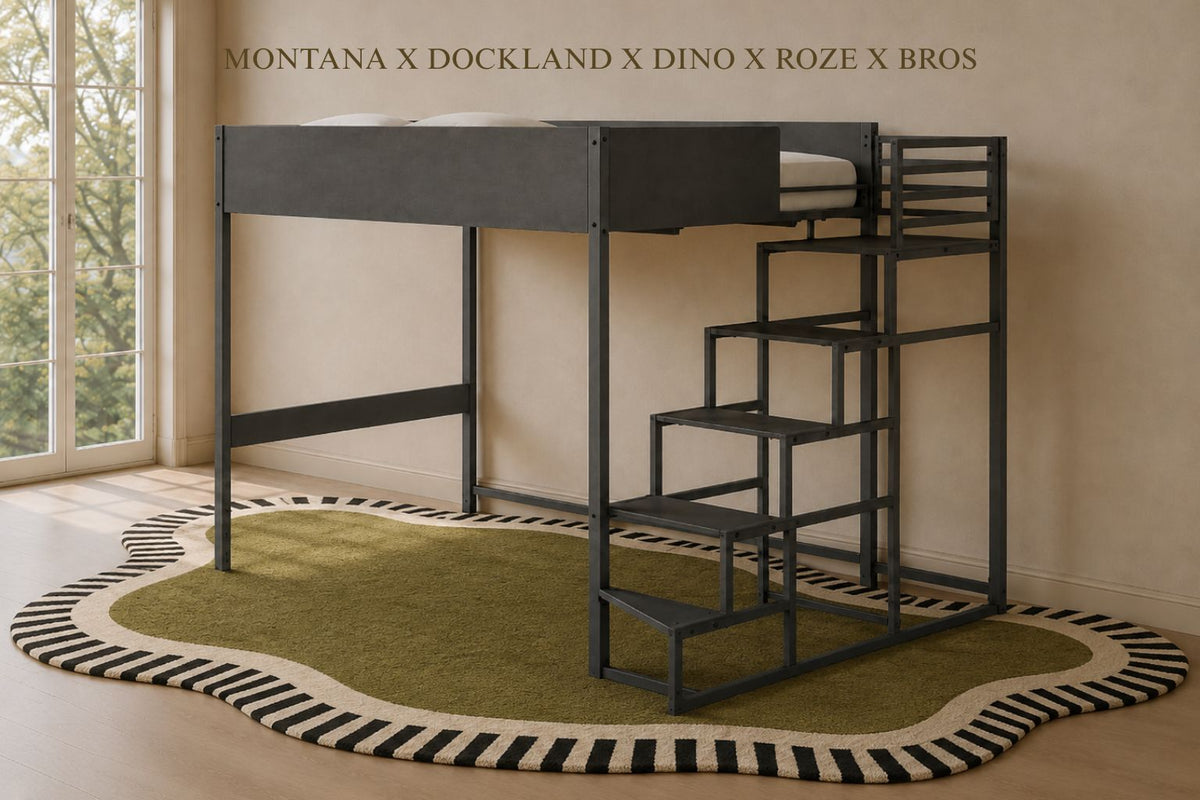
A loft bed is not only for sleeping up high. By freeing up the space normally occupied by the sleeping area, it allows you to arrange a desk, storage, a relaxation area or a multifunctional space beneath the bed.
This solution is particularly appealing in a small bedroom, studio apartment, teenager's bedroom or room that needs to serve several purposes.
The SENHO range of high beds includes various models suited to everyone's needs:
- MONTANA: a 140 × 190 cm double loft bed with a reversible staircase;
- DOCKLAND: a 140 × 190 cm double loft bed with a reversible staircase;
- DINO: a 90 × 190 cm single loft bed with an optional desk;
- ROZE: a 90 × 190 cm single loft bed with an optional desk;
- BROS: a bunk bed offering two 90 × 190 cm sleeping spaces.
These beds share the same objective: optimizing the available space. However, they differ in their type of access, usable floor area, whether or not they include a desk, and their maximum supported weight.
Comparison of SENHO loft and bunk beds
| Model | Bed type | Access | Height beneath sleeping area | Available space | Maximum supported weight |
|---|---|---|---|---|---|
| MONTANA | Double loft bed 140 × 190 cm | Reversible staircase on the left or right | 1,46 m | Approximately 2.8 m² | 200 kg |
| DOCKLAND | Double loft bed 140 × 190 cm | Reversible staircase on the left or right | 1,46 m | Approximately 2.8 m² | 200 kg |
| DINO | Single loft bed with optional desk | Fixed ladder | 1,46 m | Approximately 1.5 m² excluding desk | 100 kg |
| ROZE | Single loft bed with optional desk | Fixed ladder | 1,46 m | Approximately 1.5 m² excluding desk | 100 kg |
| BROS | Bunk bed with two single sleeping spaces | Fixed ladder | Not applicable | Two sleeping spaces within the footprint of a single bed | 100 kg per level |
The stated weights correspond to the maximum load supported by the sleeping platforms. They include the weight of the mattress and that of the sleeper or sleepers.
Each bed must be assembled and used in accordance with its assembly instructions.
Why choose a loft bed to save space?
In a standard bedroom, the bed often occupies most of the floor space.
By raising the sleeping area, the loft bed allows the same space to be used twice:
- up high for sleeping;
- under the bed for working, storing things, reading or relaxing.
This arrangement is particularly useful when the room needs to serve several purposes.
The freed-up space can be used to set up:
- a desk;
- shelves;
- a chest of drawers;
- a small sofa;
- an armchair;
- a reading corner;
- storage for clothes or toys;
- a play area;
- a computer workstation;
- a relaxation area.
The loft bed thus transforms a space dedicated solely to sleeping into a truly multifunctional area.
MONTANA and DOCKLAND: double loft beds with a reversible staircase
MONTANA and DOCKLAND are the two double loft beds in the SENHO range.
They feature a sleeping area of 140 × 190 cm, suitable for a double mattress, while leaving a large amount of free space beneath the platform.
Their main feature is their reversible staircase, which can be installed on the left or right during assembly.
A reversible staircase on the left or right
The staircase of the MONTANA and DOCKLAND beds can be assembled on either the left or right side of the structure.
This option makes it easier to adapt the bed to the layout of the bedroom.
The choice of side may depend in particular on:
- the location of the door;
- the position of the windows;
- the presence of a radiator;
- the location of electrical outlets;
- the arrangement of the other furniture;
- the space needed to move around;
- the overall shape of the room.
In a narrow bedroom or one with an unusual layout, this flexibility can make all the difference.
For example, it prevents the staircase from blocking:
- the opening of a door;
- access to a wardrobe;
- a window;
- a passageway;
- a piece of furniture already in the room.
When should you choose the side of the staircase?
The staircase orientation must be chosen before or during bed assembly.
It is therefore recommended to measure the bedroom precisely and plan the position of each piece of furniture before starting assembly.
Once the bed has been fully assembled, changing the side of the staircase may require partially dismantling the structure.
Before assembly, check in particular:
- the direction in which the door opens;
- the distance from the windows;
- the space available in front of the staircase;
- the position of the storage units;
- the walkway in the bedroom;
- access to outlets and radiators.
A height of 1.46 m beneath the loft
The MONTANA and DOCKLAND beds provide 1.46 m of clearance beneath the sleeping platform.
This height makes it possible to create a comfortable space for activities carried out while seated.
Most adults will not be able to stand fully upright beneath the bed. Nevertheless, the space is generous enough to install:
- a desk and chair;
- a small sofa;
- an armchair;
- a reading corner;
- a play area;
- low storage units;
- shelves;
- a low wardrobe;
- a computer or gaming area.
This height also helps prevent the area beneath the bed from feeling too enclosed.
Approximately 2.8 m² of space to arrange
MONTANA and DOCKLAND free up approximately 2.8 m² of floor space beneath the bed.
In a small bedroom or studio apartment, this area represents a real additional space.
It can, for example, accommodate:
- a complete desk with chair;
- a small bookcase;
- a compact sofa;
- several storage units;
- a TV corner;
- a shared workspace;
- a relaxation area for a teenager;
- a setup combining a desk and storage.
Instead of reserving one area for the bed and another for the desk, the loft bed allows these two functions to be combined vertically.
Double loft beds suitable for small spaces
MONTANA and DOCKLAND can suit different configurations:
- studio apartments;
- small bedrooms;
- teenagers’ rooms;
- guest rooms;
- student housing;
- second homes;
- shared accommodations;
- bedroom-office combinations.
They may also be suitable for a single person who wants a wider sleeping area while retaining as much floor space as possible.
How much weight do the MONTANA and DOCKLAND beds support?
The sleeping platforms of MONTANA and DOCKLAND support a stated maximum weight of 200 kg.
This capacity allows one or two people to sleep on it, provided that the total weight does not exceed this limit.
The calculation must include:
- the weight of the sleeper or sleepers;
- the weight of the mattress;
- any other item placed on the platform.
The bed must also be correctly assembled on a stable floor, in accordance with the supplied instructions.
DINO and ROZE: single loft beds with an optional desk
DINO and ROZE are single loft beds designed to accommodate a mattress of 90 × 190 cm.
Both have a desk that can be installed beneath the bed.
Unlike the stairs on the MONTANA and DOCKLAND models, their ladder has a fixed position.
A fixed, non-reversible ladder
The ladder of the DINO and ROZE beds cannot be moved from one side to the other.
It is therefore important to check its position before ordering the bed.
When planning its installation, make sure that the ladder:
- remains easily accessible;
- does not block a door;
- does not interfere with opening a wardrobe;
- is not too close to a wall;
- does not block a radiator;
- leaves enough space to climb up and down;
- does not obstruct movement around the room.
A simple floor plan of the bedroom, accompanied by a few measurements, helps prevent the layout from turning into a life-size puzzle.
Is the DINO and ROZE desk mandatory?
No. The desk supplied with the DINO and ROZE beds is optional.
The customer can choose not to assemble it.
The desk does not contribute to the structural stability of the sleeping platform. The bed can therefore be used without this desk, provided that all structural parts mentioned in the instructions are correctly assembled.
This option offers greater freedom to personalize the space beneath the bed.
How can the space be used without the supplied desk?
If you choose not to assemble the DINO or ROZE desk, the space can accommodate:
- another desk purchased separately;
- a chest of drawers;
- drawer units;
- shelves;
- an armchair;
- a small sofa;
- a reading corner;
- storage for toys;
- open space for play;
- a layout that evolves according to the user's age.
This flexibility allows the bed to adapt to the bedroom's needs over time.
A space used for play in a child's bedroom can, a few years later, become a desk area or a computer area.
What are the dimensions of the DINO and ROZE desk?
The desk supplied with the DINO and ROZE beds measures:
- length: 94 cm ;
- depth: 40 cm ;
- height: 77 cm.
These dimensions make it possible to create a compact workstation without taking up the entire available area beneath the bed.
The desk can be used for:
- do homework;
- read;
- draw;
- use a laptop;
- install a small lamp;
- organize some school supplies.
Its 40 cm depth makes it particularly suitable for bedrooms where every centimetre counts.
A height of 1.46 m beneath the sleeping platform
Like MONTANA and DOCKLAND, the DINO and ROZE beds provide a height of 1.46 m beneath the sleeping platform.
This height makes the desk comfortable to use while seated.
It also leaves enough room to create a space that does not feel excessively low or confined.
Approximately 1.5 m² of available space beneath DINO and ROZE
Excluding the desk, DINO and ROZE free up approximately 1.5 m² of usable space beneath the sleeping platform.
This area can be arranged according to the room’s layout and the user’s needs.
It can accommodate, in particular:
- storage boxes;
- a small bookcase;
- a drawer unit;
- a chair or armchair;
- a serving trolley;
- space for school supplies;
- toys;
- a compact relaxation area.
The available space may vary depending on the furniture added and how the desk is installed.
How much weight do the DINO and ROZE beds support?
The DINO and ROZE sleeping platform supports a stated maximum weight of 100 kg.
This limit includes:
- the sleeper’s weight;
- the weight of the mattress;
- any objects placed on the sleeping platform.
Before use, it is important to check that the total weight remains below the indicated maximum load.
BROS: two sleeping spaces in the footprint of a single bed
BROS differs from the other models in the range.
It is a bunk bed, not a loft bed.
The lower space is therefore not intended for a desk or storage. It contains a second 90 × 190 cm sleeping platform.
BROS therefore allows two single beds to be installed while taking up approximately the floor space of one bed.
Which rooms are suitable for installing the BROS bunk bed?
BROS is particularly suitable for:
- rooms shared by two children;
- siblings;
- guest rooms;
- second homes;
- holiday homes;
- small bedrooms;
- rooms where two separate beds would take up too much space.
This configuration preserves more floor space for storage, play or movement.
Is the BROS bed ladder reversible?
No. The BROS bunk bed ladder has a fixed position.
It cannot be moved or installed on the opposite side.
Before purchasing, you should therefore check that its position corresponds to the room’s layout.
Access to the ladder must not be obstructed by:
- a wall that is too close;
- a door;
- a wardrobe;
- a desk;
- a radiator;
- another piece of furniture.
How much weight does the BROS bunk bed support?
Each level of the BROS bunk bed supports a stated maximum weight of 100 kg.
The limit applies separately to both platforms:
- upper bunk: maximum 100 kg ;
- lower bunk: maximum 100 kg.
For each level, this weight includes the mattress and the sleeper.
The bed's total capacity does not mean that a single platform can support 200 kg. Each level must individually comply with its own 100 kg limit.
Reversible stairs or fixed ladder: what is the difference?
The access system is one of the main differences between SENHO high-bed models.
The reversible stairs on MONTANA and DOCKLAND
The reversible stairs can be installed on the left or right.
This solution offers greater flexibility for adapting the bed to:
- the shape of the room;
- the direction in which the door opens;
- the position of the windows;
- the arrangement of the furniture;
- the traffic route.
Stairs also provide a different approach to the ladder in terms of access and floor space.
The fixed ladder on DINO, ROZE and BROS
The ladders on DINO, ROZE and BROS are not reversible.
Their position must therefore be incorporated into the layout plan before purchase.
A ladder generally takes up less depth than stairs, but it offers fewer possibilities for changing the bed's orientation.
Which SENHO bed should you choose for your needs?
Choose MONTANA or DOCKLAND if you are looking for:
- a 140 × 190 cm double loft bed;
- stairs that can be installed on the left or right;
- a large amount of space available under the sleeping area;
- approximately 2.8 m² for arranging a desk, storage or a relaxation area;
- a clearance of 1.46 m under the sleeping area;
- a platform supporting up to 200 kg.
Choose DINO or ROZE if you are looking for:
- a 90 × 190 cm single loft bed;
- a compact desk supplied with the bed;
- the option not to install the desk;
- approximately 1.5 m² of usable space excluding the desk;
- a clearance of 1.46 m under the sleeping area;
- a sleeping space supporting up to 100 kg;
- a configuration compatible with a fixed ladder.
Choose BROS if you are looking for:
- two 90 × 190 cm sleeping spaces;
- a bunk bed for a shared bedroom;
- space savings compared with two separate beds;
- a fixed ladder compatible with your room;
- a maximum capacity of 100 kg on each level.
How do you measure a room before buying a loft bed?
Before choosing a high bed, measuring only the available floor space is not enough.
Several dimensions and obstacles must be taken into account.
Measure the bed's total length and width
Check the product's full dimensions, including:
- the platform;
- the stairs;
- the ladder;
- elements extending beyond the structure.
For MONTANA and DOCKLAND, take measurements with the side chosen for the stairs in mind.
Check the ceiling height
Allow enough space between the top of the mattress and the ceiling for the sleeper to get in, sit up and move around comfortably.
The available height depends on:
- total bed height;
- mattress thickness;
- ceiling height.
The thicker the mattress, the closer the sleeper is to the ceiling.
Check the doors and windows
Make sure the bed does not block:
- the bedroom door opening;
- a wardrobe door;
- a window;
- an interior shutter;
- access to storage.
Also consider how the elements open, not just their position when closed.
Check the radiators and electrical outlets
A bed must not prevent access to important equipment in the room.
In particular, identify:
- radiators;
- electrical outlets;
- switches;
- air inlets;
- cables;
- wall lights.
Allow sufficient space in front of the ladder or stairs
The user must be able to climb up and down without being obstructed by furniture.
You must therefore leave a clear area in front of access to the sleeping area.
This area must not be occupied by:
- a chair;
- a desk;
- a storage chest;
- a chest of drawers;
- toys;
- objects left on the floor.
Choose a mattress suitable for the loft bed
Choosing the right mattress is particularly important for a loft or bunk bed.
A mattress that is too thick reduces the effective protective height of the safety rails.
You must therefore always follow:
- the stated mattress dimensions;
- the maximum permitted thickness;
- the recommendations in the instructions.
For the SENHO BROS, DINO and ROZE 90 × 190 cm beds, the 15 cm NIMBUS90 mattress is a suitable option.
For the MONTANA and DOCKLAND 140 × 190 cm double loft beds, the 15 cm NIMBUS140 mattress is particularly suitable.
How should you arrange the space beneath a loft bed?
The arrangement depends mainly on the person using the bedroom and their needs.
Create a workspace
A desk beneath a loft bed brings sleeping and working together in the same area of the room.
You can add:
- a desk lamp;
- wall shelves;
- a drawer unit;
- a compact chair;
- document storage;
- a laptop stand.
DINO and ROZE already include an optional desk measuring 94 × 40 × 77 cm.
Create a relaxation area
Beneath MONTANA or DOCKLAND, the available space can accommodate:
- a small sofa;
- an armchair;
- floor cushions;
- a coffee table;
- a bookcase;
- ambient lighting.
This configuration can transform a bedroom into a more complete living space.
Add storage
The space beneath the bed can also become an organized storage area.
You can install:
- a chest of drawers;
- shelves;
- boxes;
- baskets;
- low cabinets;
- a suitable wardrobe;
- mobile drawers.
In a small bedroom, this arrangement helps free up wall and circulation space.
Frequently asked questions about SENHO loft beds
What is the best SENHO loft bed for two people?
MONTANA and DOCKLAND feature a 140 × 190 cm double sleeping area and support up to 200 kg, including the mattress. They also offer approximately 2.8 m² of available space beneath the sleeping area.
Can the staircase on the MONTANA bed be assembled on the left or right?
Yes. The staircase on the MONTANA loft bed is reversible. Its side can be chosen during assembly.
Is the staircase on the DOCKLAND bed reversible?
Yes. The staircase on the DOCKLAND bed can be installed on the left or right, depending on the room layout.
Can the ladder on the DINO, ROZE or BROS beds be moved?
No. The ladders on DINO, ROZE and BROS have a fixed position and cannot be reversed.
Is it mandatory to assemble the desk for the DINO and ROZE beds?
No. The desk supplied with the DINO and ROZE beds is optional. It does not contribute to the bed's structure and does not have to be installed.
What are the dimensions of the DINO and ROZE desk?
The desk measures 94 cm in length, 40 cm in depth and 77 cm in height.
What height is available beneath MONTANA and DOCKLAND?
Both beds provide a height of 1.46 m beneath the sleeping platform.
How much space is available beneath MONTANA and DOCKLAND?
MONTANA and DOCKLAND free up approximately 2.8 m² beneath the sleeping area. This space can accommodate a desk, storage or a relaxation area.
How much space is available beneath DINO and ROZE?
DINO and ROZE provide approximately 1.5 m² of usable space beneath the bed, excluding the desk.
How much weight do the MONTANA and DOCKLAND beds support?
Their sleeping platform supports up to 200 kg, including the mattress.
How much weight do the DINO and ROZE beds support?
The sleeping platform of each model supports up to 100 kg, including the mattress.
How much weight does the BROS bunk bed support?
Each level of the BROS bed supports up to 100 kg, including the mattress.
Which mattress should you choose for a SENHO loft bed?
A 15 cm mattress such as NIMBUS helps limit the overall height of the sleeping area. NIMBUS90 is suitable for BROS, DINO and ROZE models, while NIMBUS140 is suitable for MONTANA and DOCKLAND models. The maximum thickness specified in the bed instructions must always be observed.
MONTANA, DOCKLAND, DINO, ROZE or BROS: which model should you choose?
Choose MONTANA or DOCKLAND if you need a double sleeping space, a reversible staircase and a large open area beneath the bed.
Choose DINO or ROZE if you are looking for a single loft bed with a compact desk that you can choose to assemble or not.
Choose BROS if you want to install two single sleeping spaces in a bedroom while preserving as much available floor space as possible.
The right model depends above all on:
- of the number of sleepers;
- of the mattress size;
- of the room layout;
- of the desired access position;
- of the intended use beneath the sleeping area;
- of the required maximum load.
By carefully measuring the room before purchase, a SENHO loft or bunk bed can become a true space-planning tool, capable of transforming every square metre into useful space.



Leave a comment
This site is protected by hCaptcha and the hCaptcha Privacy Policy and Terms of Service apply.